



The United States of America recently celebrated its 250th birthday.
People like Ron Taylor are a big part of the reason why.
The retired Hoosier Energy employee and Vietnam Veteran participated in the 50th Indy Honor Flight to Washington, D.C., on May 30, 2026.
“It was really well organized, well done and greatly appreciated,” said Taylor. “For those of us who are Vietnam veterans, it was probably the first time since I came home from there in 1970 that anybody actually said thank you. It was a great trip.”
Indy Honor Flight is a non-profit organization created specifically as a way to honor Indiana’s veterans. Each Honor Flight is a one-day, no-cost trip to Washington, D.C., to visit the memorials built in veterans’ honor, whether that’s World War II, Korea or Vietnam. Veterans who served in any military capacity between 1941 and 1975 are currently eligible to participate.
Taylor, who retired in 2014 after 29 years at Hoosier Energy – the last 14 as lead instructor for the HEATS (Hoosier Energy Apprenticeship Training & Safety) program, joined the waiting list several years ago and got a surprise phone call this spring asking if he was still interested. There was no hesitation for Taylor, who was a Specialist in the U.S. Army as an M88 Tank Operator during three years in the service from 1969-1971, including one year in Vietnam.
“Most of the people in the service at that time were just kids, and most of us had never been away from home,” he said.
More than 50 years later, Taylor had never been to the nation’s capital.
“Everyone says I’d like to go to D.C. and see stuff, but I just never got it done,” he said. “The biggest thing for me was the Lincoln Memorial. We were loaded on buses and went from one monument to the next, things like the statue of the soldiers raising the flag at Iwo Jima.
“I’m just thankful we got to go and see everything.”
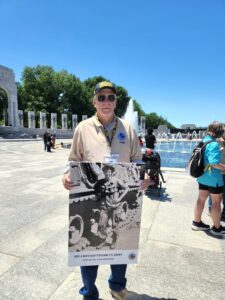
Former Hoosier Energy employee Ron Taylor poses with a picture of himself in the U.S. Army during his Indy Honor Flight trip on May 30, 2026.
It was also a family affair as Taylor was joined on the flight by his daughter, Kelly, while his son, Kyle, flew in from Oregon to meet them. He also has a niece living in the D.C. area who participated.
The whole experience was a nearly 36-hour whirlwind, starting with a dinner at North Central High School in Indianapolis on Friday night and returning to the high school at 5 a.m. Saturday morning. Buses transported participants to the airport for the flight to D.C.
“When we got to the airport, there were people waving flags and celebrating,” Taylor said.
During the day in D.C., each veteran was presented with a poster-size picture of themselves, which they would later collect upon their return to the high school Saturday evening. That also served as a pretense for a final celebration of the veterans, where Taylor was surprised to see his son, who had left Washington “for an earlier flight” home. In all, approximately 15 family members – brother, sister, nieces, nephews, cousins – were on hand to honor Taylor.
“It was like that for everybody, and they call your name one at a time,” he recalled. “How that many people knew and kept it a secret, I have no idea. It was great.”
Among the many messages and letters Taylor received was one from Hoosier Energy President & CEO Donna Walker.
“On behalf of Hoosier Energy, thank you for everything you have given to our nation and to the cooperative family. We are proud to celebrate you,” she wrote.
The Stinesville native started at Hoosier in 1985 after previously working for the Public Service in Martinsville, beginning as an apprentice lineman and moving to Safety & Training in 1999.
“Hoosier Energy was a lifesaver because I wasn’t sure what I was going to do,” Taylor said. “I was fortunate to get an opportunity, went to work at Worthington and was there until moving to Safety & Training.”
Then his office moved to headquarters north of Bloomington on Old 37.
Taylor has always enjoyed traveling and has spent his retirement doing plenty of that, including multiple trips to Alaska. The seeds for that were planted during his time at Hoosier.
“The first time I went there, one of the Indiana statewide meetings were being held in Anchorage,” he recalled. “I told my boss, ‘I’m going to Anchorage, be gone for a week. See you when I get back.’”
But most of Taylor’s travels have been in the West and Northwest, so taking the Honor Flight to Washington, D.C., was something special.
“I like to travel and see new things, but this was a once-in-a-lifetime thing for me,” he said.